

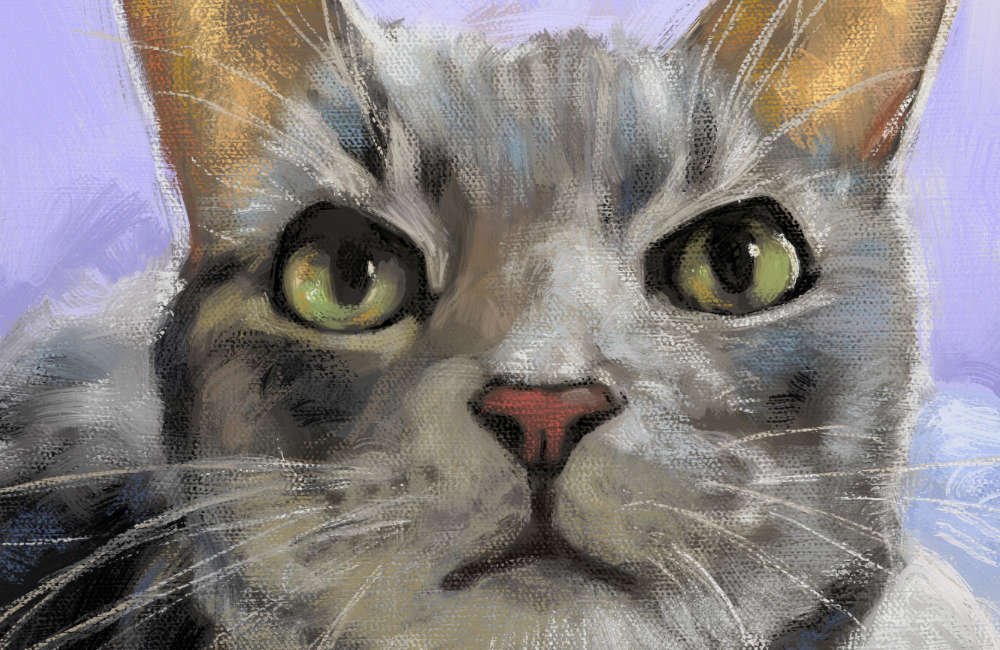
If you think cats can be difficult, you should try painting them.
I’m confident when it comes to dogs. I do so many. But cats still can give me fits.
As with all my pet portrait work, the goal is to finish with a reasonable likeness of the subject. With that in mind, it helps to have a good handle on the general anatomy and structure of the animal in question.
Through years of painting dogs, I’ve internalized a lot of anatomical characteristics. As a result, my dog portraits –once I’ve settled on a composition– generally proceed quickly and without a hitch, though there are exceptions.
But when it comes to cats, I’m still learning the finer points of cat anatomy. The usual shape of ears; eye placement and size; whisker lengths and number, etc.
And noses. Of all the aspects of cat portraits, it’s surprising that the most difficult area for me to capture realistically is the nose.
It's so darn tiny!
In the end, the trick to refining one’s skill in painting (and most everything else) is to do it. Do it a lot. Do it until you’ve got it down in the dark.
To that end, I saw a cat photo on X a while back and asked the photographer if I could use it as a reference to practice my cat painting.
He graciously agreed.
It was a slow time for me, so I decided to work on it relentlessly until I got it right. It took me about a week with three or four different versions. The final version was awesome if I do say so myself. I painted it with a new confidence in nearly every stroke, and by then I knew exactly how that nose was going to look.
I’m not saying I now know everything about painting cats, but my confidence level has really grown.
And that’s half the battle.
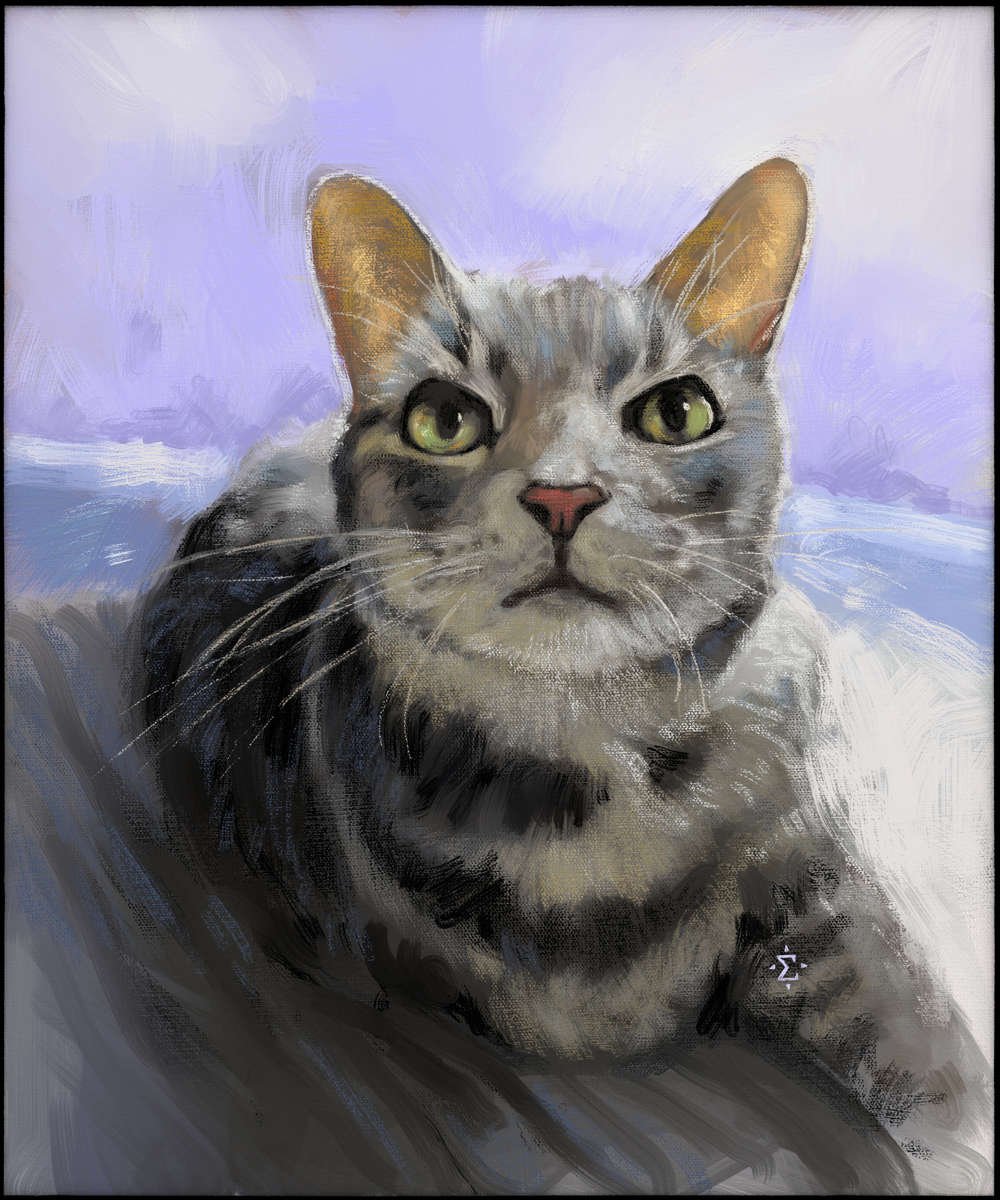
Lilac Cat (11x14, digital)

About the Author
Topdog is Steve Merryman, a retired graphic designer, illustrator, and curmudgeon-in-training. Steve can often be found working on a portrait commission or some other artwork. Steve fills his days by painting, writing, shootin' guns, cuttin' trees, hiking with his dogs, and shaking his head at world events, all while searching for the perfect cheeseburger. He is occasionally without pants.
Comments 5
Fascinating work to get the details correct. I liked your line about getting it right by just digging in and do it (over and over). Is there ‘muscle memory’ in painting?
Author
Muscle memory? Yes. I believe there is.
You train your eye and hand to work together. It doesn’t always happen, but with practice it tends to happen more frequently. I love losing my self in a painting, becoming one with the form so that every brush stroke reveals more depth and shape.
When it hits me, it’s like time-travel. I’ll finally step away and realize I’ve been at it for three hours solid, and I’ve got to pee RIGHT NOW!
A full bladder is the enemy of good art. I should put that on a t-shirt!
You definitely should. It also makes an uncomfortable morning when you want a few more cat winks but it won’t wait for that. Good answer to my question.
Well done!
Author
Gracias!